
Ultra-Short Cantilevers (USC)
After the commercialization of Arrow™ UHF AFM probe since 2014 the NanoWorld R&D team in collaboration with nanotools GmbH started working on the development of a second generation of High Speed Scanning AFM probes called Ultra-Short Cantilevers.
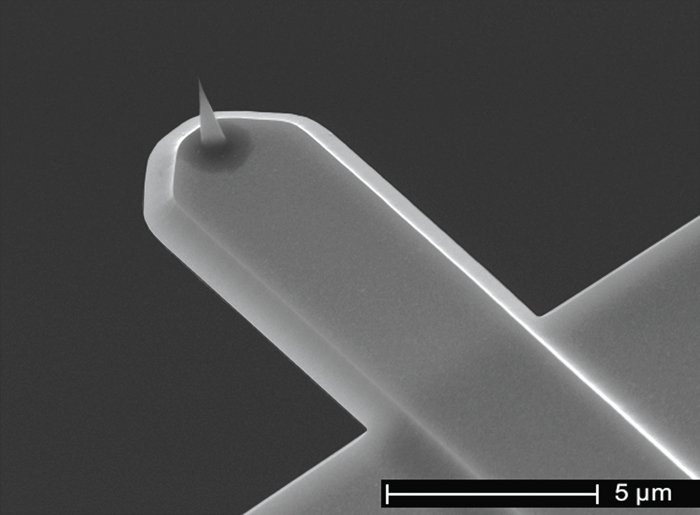

Many different AFM cantilever and AFM tip materials have been investigated and cantilevers with different dimensions have been fabricated and tested.
These investigations resulted in the following basic types:
1) NanoWorld Ultra-Short Cantilevers
Product commercialized by NanoWorld since 2014 with the name Ultra-Short Cantilevers (USC).
During their development phase, these probes were called Ultra-Short New Material Cantilevers (USC-NM).
Also available on demand in a tipless version as NANOSENSORS™ Special Development item.
2) Ultra-Short Silicon Nitride Cantilevers
Available on demand as NANOSENSORS™ Special Development item.
All these AFM probe types feature the same Electron Beam Deposited (EBD) sharp AFM tip manufactured by nanotools GmbH.

As in High-Speed AFM (HS-AFM) the AFM tip can travel at a speed of a few mm/s in contact with the sample, AFM tip wear becomes a very critical issue.
This problem has been solved by using a HDC / DLC AFM tip which has a Young's modulus eight times higher than Silicon. This results in a much lower tip wear compared to a standard silicon AFM tip.
Moreover the hydrophobic properties of the HDC / DLC AFM tip enable its use for biological applications where the interactions between the AFM tip and the sample have to be as weak as possible in order to be non-destructive.
NANOSENSORS™ is a trademark of NanoWorld AG.